Water Management on the Emerald Necklace
Introduction
The Emerald Necklace is a park system centrally located in Boston, originally designed by Frederick Law Olmsted. In this Emerald Necklace Transect, I aim to explore the water management aspect of the emerald necklace park system. This is a multi-faceted subject that takes into account land usage, climate change, flooding, and several other topics. As a whole, the development of the emerald necklace had a profound impact on surrounding communities and the local urban environment, and the surrounding environment can still be felt today in many ways– though some are just scars of past misdeeds. The development of the Back Bay Fens, for example, was constructed over the site of a black community, relying on its demolition for the project. (1) The question is then raised of whether the park was a net positive– though its construction showed a blatant disregard for the lives and wellbeing of minority communities, but creating the opportunity to experience green space for so many– this is not a difficult question, but these are also not the only two options– destroying the park or preserving the community. This transect aims to show a third option: one of being cognisant of these stories and mindfully moving forward. This is what being an anti-racist means, like Kendi talks about in his book How to Be an Antiracist. To him, the understanding of the struggles of black people will never be enough to change policy, because black people have been marginalized for so long. (2) Like his book, this transect aims to examine several disparate subjects and connect them in a thoughtful way. The overall theme is the racialized landscape, as that has been a focus of a large part of the class, but some topics are only tangentially related. In some cases, water is only a jumping off point, more of a prompt than a rule, to take the project in different directions. More often than not, the subject strays from water almost entirely, but they always connect to the racialized landscape, as is natural in a city.
Several of the early readings in the class, namely Reciprocal Landscapes and the Boston Globe’s Spotlight series on racism in Boston, echo throughout this tour. First, the messages of Reciprocal Landscapes are ever-present. Reciprocal Landscapes, in essence, teaches the reader how to engage with a landscape and analyze it critically. Through several interesting examples of relationships and reciprocations between one landscape and another, Jane Hutton aims to get the reader to think more deeply about where materials come from, the interactions between landscapes and other areas, etc. (3)
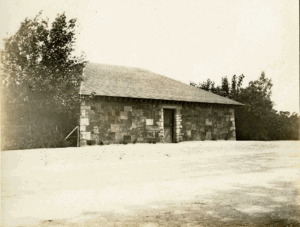
For example, if analyzing a part of the Emerald Necklace critically, namely the Shattuck Visitor’s Center at the Fens, which used to be a mill-powered water pumping station, one might investigate the history of the practices associated, and the modern day usage of the building– does pumping water have anything to do with the racialization of the local landscape? Not on a surface level, but the history of the south’s great migration has a great deal to do with Boston and water management– deceptive land practices and the great migration, therefore, created the environment around the Fens that was destroyed in its construction. (4) The white neighborhood was able to fight back against having their land seized, but the black neighborhood had practically zero say in the matter.
A natural connection between all of the sites is in the racialized landscape, which is explored in depth in the tour, but that is not a very creative one. In the tour, race is tied into several more specific issues, such as the zoning of the neighborhoods surrounding the Fens. The most interesting exploration of the reciprocal nature of the water systems along the Emerald Necklace is in the exploration of the Breweries and Tap Houses along the historic Stony Brook River, which was compartmentalized in the late 19th century. This had a distinct impact on the surrounding area, driving away businesses which relied on the supply of fresh water– industrial factories, breweries, among others. (5) This is interesting to consider when taking into account the current state of roads such as Columbus avenue, where there are currently a large number of liquor stores, after historic battles in the 20th century to keep new liquor stores from coming in. Regardless, this is a heavily racialized issue, as Columbus ave runs through Lower Roxbury, a majority black community.
I aim for the reader to come away from this tour with an appreciation for the complexities of the water management systems and their histories as they relate to Olmsted’s park system. Further than that, I aim to make the reader question the institutions they benefit from, just as Hutton does in her book. I aim to make people examine their surroundings with a critical eye like Kendi does in his book; I want people to be more aware of the power structures around them. (6) Only then, when there is enough public will, can change happen. All of the societal shifts and power struggles illustrated in this tour relate, in some way or another, to race. The sole purpose of this transect is not to attempt to solve racism, but merely to attempt to make people more aware of this microcosm of the subject, specifically in Boston and specifically regarding water systems. That being said, a majority of these principles apply to other cities across the country, as is the nature of systemic racism. Boston isn’t special for being racist.
References
- Norman, Al. “The Community First Olmstead Plan - Mass.gov.” Mass.gov, Community First, 2018, https://www.mass.gov/doc/community-first-olmstead-plan-0/download.
- Kendi, Ibram X. How to Be an Antiracist. Vintage, 2021.
- Hutton, Jane Elizabeth. Reciprocal Landscapes: Stories of Material Movements. Routledge, an Imprint of the Taylor & Francis Group, 2020.
- Norman, Al. “The Community First Olmstead Plan - Mass.gov.” Mass.gov, Community First, 2018, https://www.mass.gov/doc/community-first-olmstead-plan-0/download.
- Marx, Walter H. “The Saga of Stony Brook.” Jamaica Plain Historical Society, Jamaica Plain Historical Society, 5 July 2020, https://www.jphs.org/locales/2004/1/5/the-saga-of-stony-brook.html.
- Ibram X Kendi, How to Be an Antiracist.
Water Management on the Emerald Necklace
By Liam Scott
This Transect looks at intersecting aspects of water and water management on the Emerald Necklace, with a focus on the racialized landscape.
Keywords: water, race, public, system, interconnected